Identification and Health Risks of an Emerging Means of Drug Use in Correctional Facilities
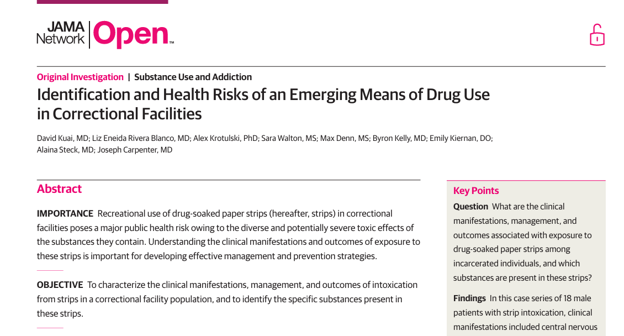
A JAMA Network Open study (Kuai et al., Dec 2024) followed 18 people at an Atlanta county jail who were hospitalized after using drug-soaked paper strips. Here's what happened to them:
- 94% had severe central nervous system depression
- 61% had dangerously low heart rates
- 22% had seizures
- 3 went to the ICU, 2 were intubated, and 1 died
Lab tests found potent synthetic cannabinoids like MDMB-4en-PINACA on the strips, along with traces of nitazene opioids, fentanyl and xylazine. The drug is often unevenly spread across a sheet, so one strip can be far stronger than the next.
The researchers describe how the paper usually gets in: people pose as attorneys and mail it in envelopes made to look like legal mail. Because that mail is confidential, staff generally can't open or inspect it.
That leaves corrections officers in an impossible spot. They're expected to protect attorney-client privilege while handling paper that may be laced with drugs, and they're the first responders when someone in a cell stops breathing.
At Lightning Law, we take the paper out of the process:
Defense attorneys upload legal documents directly to our secure platform
Incarcerated clients review them on facility tablets, and the privilege stays intact
Attorneys meet clients by video or in person, they review digital documents together and collect e-signatures
Staff stop being the middleman for legal mail
When legal mail is digital, there's nothing to soak and nothing to smuggle.
