Paper That Kills: How Prisons and Lawmakers Are Rethinking Legal Mail
Paper That Kills: How Prisons and Lawmakers AreRethinking Legal Mail
On Aug. 9, 2024, Marc Fischer opened a letter at the federalpenitentiary in Atwater, California. He fell ill and died at the hospital.
The envelope was marked as legal mail. It wasn't. It carriedpaper laced with narcotics, and a second officer who handled it was alsosickened. Federal prosecutors later charged an incarcerated man andtwo people on the outside.
That letter captures the problem every jail and prison nowfaces. Legal mail is protected for good reason: it carries a person's right tocounsel. But that same protection has made it the most dangerous envelope inthe mailroom.
So how do we keep officers and incarcerated people safewithout cutting anyone off from their lawyer?
Why legal mail is the loophole
Most incarcerated people no longer touch their own mail. Atleast 78% of the roughly 1.2 million people in U.S. prisons now receive lettersas scans or photocopies.
Legal mail is different. Privileged correspondence isgenerally opened only in the recipient's presence and never read. Scanning orcopying it creates real legal risk: scanners and copiers store what theyprocess, which can compromise attorney-client privilege, interfere with theSixth Amendment right to counsel, and chill speech protected by the FirstAmendment.
That leaves legal mail in a category of its own, and smugglersknow it. Forged law-firm letterhead and a convincing return address can carrydrug-soaked paper straight past screening.
A large, organized trade
Fake legal mail isn't a one-off. It's a business.
- Texas, 2025: Federal agents seized three websites selling K2-soaked paper as "fictitious legal mail," shipping tens of thousands of parcels to prisons each year. One sheet sold for about $1,000 inside.
- New York, 2025: A woman who mailed synthetic-cannabinoid paper to state prisons disguised as attorney mail was sentenced to more than eight years.
- Florida, 2024: An investigation at the Duval County Jail followed 23 overdoses. After the arrests, overdoses fell 61%.
- Vermont and Massachusetts, 2025: Corrections leaders told lawmakers that falsified legal mail and K2-soaked paper are among their biggest threats, including to staff.
The drugs are getting stronger
Fentanyl and synthetic cannabinoids are now joined bynitazenes, synthetic opioids some of which are about 10 times as potent as fentanyl. Cook County Jail inChicago has seized pages carrying nitazenes, xylazine and syntheticcannabinoids, up to 10 drugs on a single sheet. Some of them can't bereversed with naloxone, and many slip past standard drug tests.
The burden on the people who open the mail
Every legal envelope has to be handled by hand. InMassachusetts state prisons, for example, privileged mail is opened only in front of the recipient and recorded in a Privileged MailLogbook.
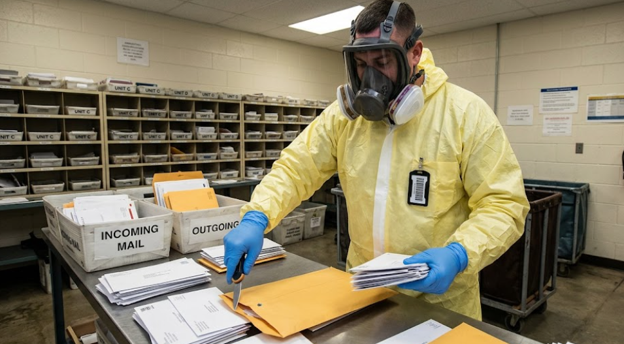
That means an officer sorts each envelope, logs it, bringsthe person to the mailroom or unit, and opens it in front of them. Every stepputs staff in contact with paper that may carry an invisible, potentiallylethal dose. Every step also takes time that short-staffed facilities don'thave.
Digital legal mail takes the paper out of the equation.
Access has to keep up too
Safety is half the story. The other half is whether peoplefacing charges can see the case against them.
Evidence today arrives as body-camera video, phoneextractions and audio files. Yet many jails have no way for a detainee to watchany of it. And here's the irony: prosecutors send defense counsel digitalfiles, which then often have to be printed just to get them into a jail orprison.
Utah decided that wasn't good enough. S.B. 194, sponsored by Sen. Stephanie Pitcher and Rep.Tyler Clancy, took effect May 7, 2025. It requires every county jail to givepeople awaiting trial or sentencing:
- a private, confidential space to review evidence with their lawyer, and
- the means to review "digital, audio, video, or other technological evidence," with or without counsel present.
Jails can use their own computers, tablets or kiosks, orapprove a device supplied by defense counsel. The bill cleared the SenateJudiciary Committee without recorded opposition.
Where lawmakers stand
Other states are wrestling with the same balance:
- New York: S8492 / A9072, from Sen. Dan Stec and Asm. Scott Gray, would create a digital legal mail platform. Law offices would register and upload documents, and recipients would read them on tablets or law library computers. The Senate version stalled in committee in May 2026; the Assembly version is still pending.
- Illinois and Nevada: Both are trying to scan general mail while keeping legal mail on paper, through Illinois' new scanning rule and Nevada's 2023 original-mail law. That keeps the paper risk in place.
- Congress: The bipartisan Effective Assistance of Counsel in the Digital Era Act, reintroduced in February 2026, would stop the Bureau of Prisons from monitoring privileged email between people in federal prison and their lawyers. A version passed the House overwhelmingly in 2021 but did not become law.
What we're seeing at Lightning Law
Legislation is moving slowly. Facilities aren't waiting.
We're seeing Lightning Law's digital legal mail adopted infacilities across the country. Our name is showing up in more and more RFPs,and where it isn't, the specs often mirror exactly what our platform does.
One recent county RFP asked for a fully integrated legalcommunication platform for residents, covering:
- Unlimited receipt of legal documents through a secure attorney portal
- Annotation tools: comments, markup, highlighting and versioning
- Organization by folders, tags and search
- Retention and deletion rules that protect privilege
- Secure attorney-client messaging with threads, timestamps and delivery confirmation
- On-demand or scheduled audio calls, plus video
- E-signatures for legal documents
- Privilege protection, with non-privileged usage data available to the facility for audits
That list tells you where the field is heading. Facilitieswant legal communication that is safe for staff, private for attorneys andclients, and accountable for administrators, all at once.
The bottom line
Safety and access aren't opposing goals. A secure digitalchannel can protect the officer who would have opened that envelope, and theperson whose case depends on what's inside it.
How is your facility, office or state handling legal mailtoday? We'd like to hear what's working, and what isn't, in the comments.
#CriminalJustice #Corrections #LegalTech#AttorneyClientPrivilege #PublicSafety #JailSafety #RightToCounsel
Sources
- U.S. Attorney, E.D. Cal.: Three charged after death of USP Atwater staff member
- IRS-CI: Websites seized in prison drug distribution scheme (Mar. 2025)
- Freedom Magazine: Drug-soaked "attorney" correspondence (Oct. 2025)
- Citizen Portal: Vermont DOC on falsified legal mail (May 2025)
- Citizen Portal: Massachusetts sheriffs on K2 (May 2025)
- CBS News: What are nitazenes?
- Hoodline: Cook County Jail drug-soaked paper (Apr. 2026)
- 103 CMR 481.00: Massachusetts DOC inmate mail regulation
- Utah S.B. 194 (2025), enrolled text
- Citizen Portal: Utah committee approves SB 194
- NY Senate S8492 and Assembly A9072
- Capitol News Illinois: Oversight panel OKs digitized prison mail rule (Jan. 2026)
- Nevada Current: NDOC plans more limits on prison mail (Apr. 2026)
- Sen. Wyden: Effective Assistance of Counsel in the Digital Era Act (Feb. 2026)
